What MS-PS2-2 asks students to investigate, how to teach balanced and unbalanced forces, and free simulations where students measure forces and motion themselves.
Plan an investigation to provide evidence that the change in an object's motion depends on the sum of the forces on the object and the mass of the object.MS-PS2-2 · Motion and Stability: Forces and Interactions · Science and Engineering Practice: Planning and Carrying Out Investigations · Crosscutting Concept: Stability and Change
Clarification statement: the emphasis is on balanced (Newton's first law) and unbalanced forces in a system, qualitative comparisons of forces, mass and changes in motion (Newton's second law), frame of reference, and specification of units.
Assessment boundary: limited to forces and changes in motion in one dimension in an inertial reference frame, and to change in one variable at a time. Assessment does not include the use of trigonometry.
Core idea (PS2.A): the motion of an object is determined by the sum of the forces acting on it. If the total force is not zero, its motion will change. The greater the mass, the greater the force needed for the same change in motion.
MS-PS2-2 in plain language
I can add up the forces on an object to find the net force.
I can predict that balanced forces mean no change in motion, and unbalanced forces mean the object speeds up, slows down or turns.
I can show that a bigger net force causes a bigger change in motion, and that more mass means a smaller change for the same force.
I can plan a fair test that changes only one variable at a time.
Key ideas and vocabulary
Net force: the sum of all forces. 10 N right and 4 N left make a net force of 6 N right.
Balanced forces: net force = 0. The object stays at rest or keeps a steady speed and direction (Newton's first law, inertia).
Unbalanced forces: net force ≠ 0, so the motion changes.
Acceleration: any change in speed or direction. Acceleration = net force ÷ mass (Newton's second law).
Units: force in newtons (N), mass in kilograms (kg), speed in meters per second (m/s).
Common misconceptions
"A moving object needs a force to keep moving." It needs a force only to change its motion. Things slow down because friction and drag are forces acting against the motion.
"If something is moving, the forces can't be balanced." A plane in steady, level flight has balanced forces: lift equals weight and thrust equals drag.
"Heavier objects fall faster." Without air resistance, all objects fall with the same acceleration. Air resistance is what makes a feather slower.
A ready-to-use lesson sequence
Hook (5 min). Slide a book across a desk. It stops. Ask: "What force stopped it? What would happen with no friction at all?"
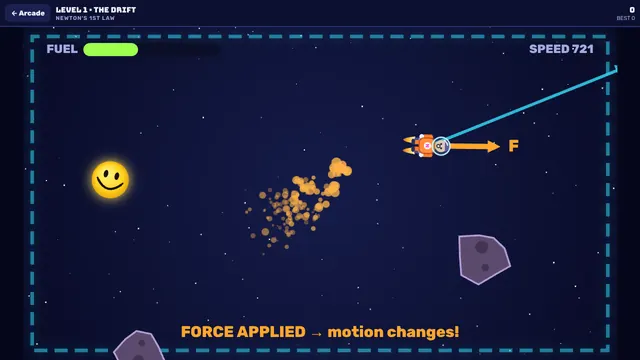
Inertia and mass (15 min). In Newton's Arcade, students drift an astronaut through space (first law) and haul crates in a truck that gets harder to speed up and stop as it gets heavier (second law).
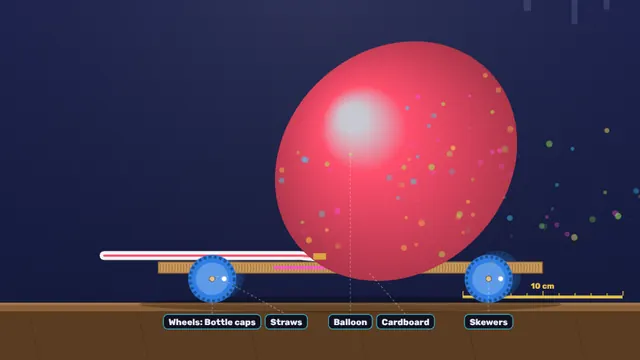
Investigate (20 min). In the Scooter Workshop, students change one design variable at a time, such as the mass of the body or the power source, and record how the scooter's motion changes.
Apply (optional). In Valley Flight School, students compare the unbalanced forces on the takeoff roll with the balanced forces in level cruise, using their own flight data.
Sample assessment question
QuestionTwo identical carts are pushed with the same force. Cart B has 3 bricks taped to it. Which cart speeds up more, and why? What would you keep the same to make this a fair test?
Show the answer
Cart A (no bricks) speeds up more. The same net force produces a smaller change in motion for an object with more mass. Keep the force, the surface, the starting position and the distance measured the same; change only the mass.
Try it free with your class
Free, no login, runs on Chromebooks, iPads and phones.
Fly a 3D plane from takeoff to landing. Time freezes at 7 lab stops where you use your own flight data to work out forces, Newton's laws, and kinetic and potential energy.
What is the difference between balanced and unbalanced forces?
Balanced forces add up to a net force of zero, so the object's motion does not change: it stays still or keeps moving at the same speed in the same direction. Unbalanced forces have a net force that is not zero, so the object speeds up, slows down or changes direction.
Do students need F = ma for MS-PS2-2?
The standard emphasizes qualitative comparisons of forces, mass and changes in motion, one variable at a time. F = ma is a common and helpful extension in 8th grade, but the assessment focuses on the relationships, not on trigonometry or complex calculations.
Why does MS-PS2-2 mention frame of reference and units?
Motion is always described compared to something (the ground, the car you are riding in), and measurements need agreed-upon units such as meters, seconds and newtons so others can understand and repeat the investigation.
NGSS is a registered trademark of WestEd. Neither WestEd nor the lead states and partners that developed the Next Generation Science Standards were involved in the production of this page, and they do not endorse it. Standard text is quoted from the NGSS (Achieve, Inc.).
 Grade 8Simulation