 Grade 8Game
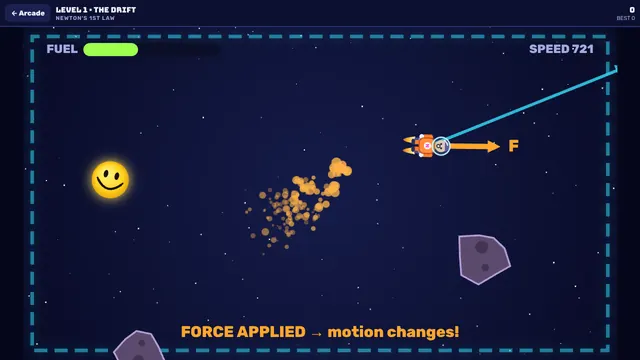
Newton's Arcade
Three arcade games, one for each of Newton's laws of motion, plus a final quiz. Score 100% to become a Newton Master.
FORCES & MOTION · NGSS MS-PS2
Teacher guide & standards
What MS-PS2-1 asks for, how to teach equal and opposite forces so students actually believe them, and free activities that put the third law in students' hands.
Apply Newton's Third Law to design a solution to a problem involving the motion of two colliding objects.*MS-PS2-1 · Motion and Stability: Forces and Interactions · Science and Engineering Practice: Constructing Explanations and Designing Solutions · Crosscutting Concept: Systems and System Models · *integrates engineering
Clarification statement: examples of practical problems include the impact of collisions between two cars, between a car and a stationary object, and between a meteor and a space vehicle.
Assessment boundary: limited to vertical or horizontal interactions in one dimension.
Core idea (PS2.A): for any pair of interacting objects, the force exerted by the first object on the second is equal in strength to the force the second exerts on the first, but in the opposite direction.
The forces are equal in size and opposite in direction (Newton's third law). The bug is hurt because it has a tiny mass, so the same force gives it a huge change in motion, while the car's large mass means its motion barely changes.
Free, no login, runs on Chromebooks, iPads and phones.
Grade 8Game
Three arcade games, one for each of Newton's laws of motion, plus a final quiz. Score 100% to become a Newton Master.
 Grade 8Simulation
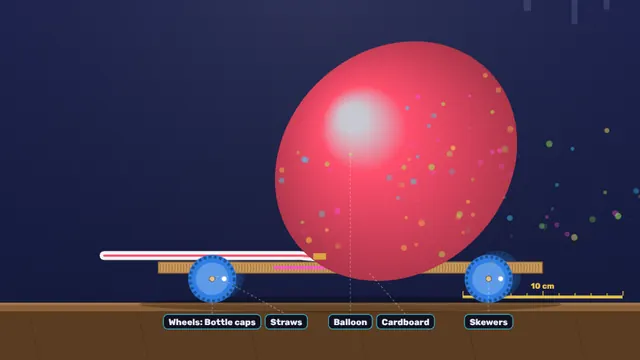
Build a Newton scooter from household parts in a virtual garage, test it, improve it, and lock in a blueprint with a shopping list for the real build.
 Grade 8Simulation
Fly a 3D plane from takeoff to landing. Time freezes at 7 lab stops where you use your own flight data to work out forces, Newton's laws, and kinetic and potential energy.
Yes. The asterisk on MS-PS2-1 means it integrates engineering design. Students apply Newton's third law to design a solution to a problem involving two colliding objects, such as a bumper, a helmet or a package for an egg drop.
Because they act on different objects. The force of the car on the bug acts on the bug, and the force of the bug on the car acts on the car. Forces only cancel when they act on the same object.
Assessment is limited to vertical or horizontal interactions in one dimension, so students do not need angles or trigonometry.
NGSS is a registered trademark of WestEd. Neither WestEd nor the lead states and partners that developed the Next Generation Science Standards were involved in the production of this page, and they do not endorse it. Standard text is quoted from the NGSS (Achieve, Inc.).