Valley Flight School
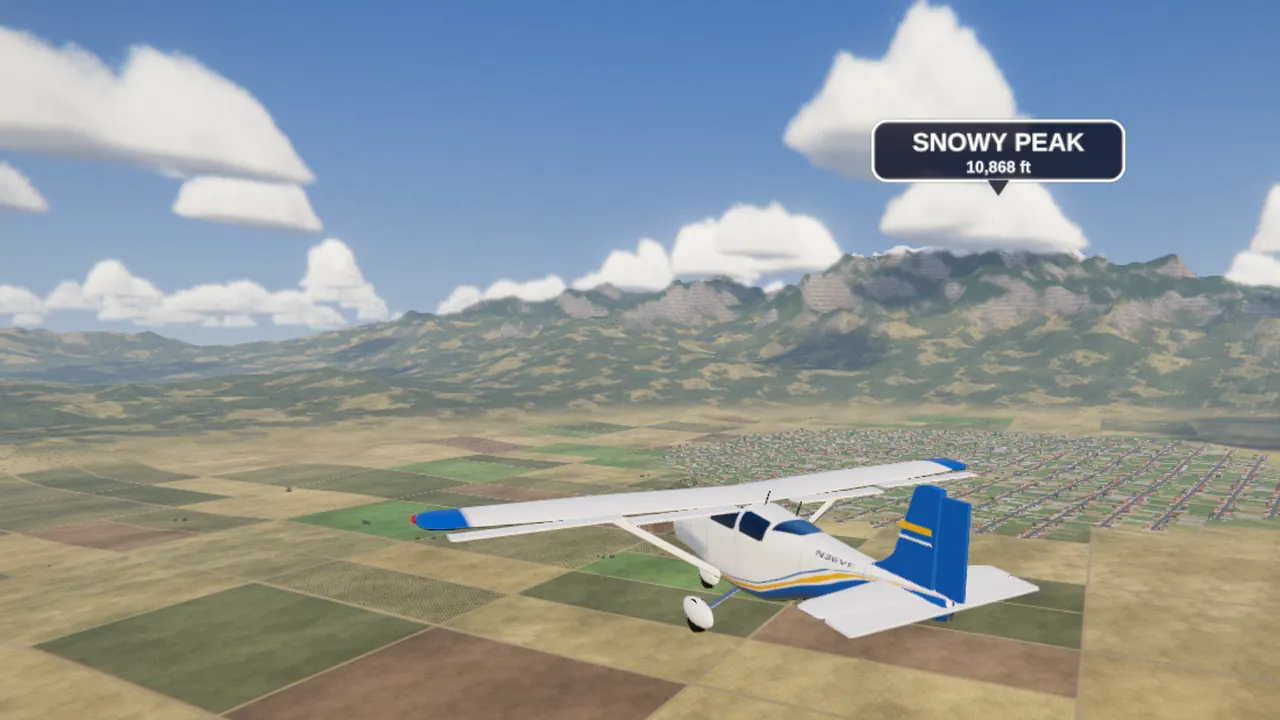
A free 3D flight simulator lab. Students fly a small plane from takeoff to landing, and the flight freezes at seven lab stops where they use their own flight data to review forces, motion, and energy.
What students do
Students type their name, pick the Interactive Lab, and fly one complete flight in a training plane out of a mountain valley airport. They take off, climb, make a turn, cruise through a 2,000 m speed trap, glide with the engine at idle, and land. Step-by-step flight cards tell them exactly what to do next.
Seven times during the flight, time freezes. Force arrows appear on the plane, and a flight recorder shows the numbers from that moment of the student's own flight: speed, height, time, and engine thrust. Students use those numbers to calculate and explain what is happening. Wrong answers get a targeted hint, the worked answer appears after three tries, and a calculator is built in.
The lab ends with a one-screen lab report that students screenshot and turn in. There is also a Guided Flight mode with step-by-step flying lessons.
Calculate the plane's weight, the acceleration on the runway, and the net force that sped it up.
Calculate KE at liftoff and GPE at 300 m, then test a prediction about which took more energy.
Newton's 1st law in level flight, the speed trap (speed = distance ÷ time), and total mechanical energy.
Where the energy goes in a glide, KE at touchdown, braking acceleration, and the stopping force.
The science behind Valley Flight School
Forces and Newton's laws
Net force = mass × acceleration. When the forces on an object are balanced, its speed and direction stay the same. When they are unbalanced, its motion changes.
Parked on the runway, the plane's weight (mass × 9.8 m/s²) is balanced by the runway pushing up, so the net force is zero. On the takeoff roll, thrust is bigger than drag and friction, and students calculate the acceleration and the net force from their own speed and time. In level cruise, lift balances weight and thrust balances drag, so the plane keeps a steady speed (Newton's 1st law). The propeller pushes air backward and the air pushes the plane forward (Newton's 3rd law). When the brakes stop the plane, students' bodies keep moving forward until the seat belt stops them.
Kinetic and potential energy
KE = ½ × m × v² and GPE = m × g × h. Energy is measured in joules.
Students calculate the plane's kinetic energy at liftoff, in cruise, and at touchdown, and its gravitational potential energy at 300 m and in cruise, using the runway as height zero. In the speed trap they find that flying twice as fast would mean four times the kinetic energy, because speed is squared.
Conservation of energy
Energy is not created or destroyed. It changes form and moves between objects.
The engine changes chemical energy in the fuel into kinetic and potential energy. In the idle glide, the plane loses a lot of potential energy without speeding up much (it often slows down), so students track where that energy went: into the air as thermal energy, because of drag. At the end, the brakes change the plane's kinetic energy into thermal energy. The report shows an energy chart of the student's own flight.
NGSS alignment
Valley Flight School is a review lab that pulls together a force and motion unit and an energy unit.
| Standard | What it says | How the simulation supports it |
|---|---|---|
| MS-PS2-2 | Plan an investigation to provide evidence that the change in an object's motion depends on the sum of the forces on the object and the mass of the object. | Students use their own takeoff data to find acceleration and net force, compare balanced forces in cruise with unbalanced forces on the runway, and calculate the braking force. |
| MS-PS3-1 | Construct and interpret graphical displays of data to describe the relationships of kinetic energy to the mass of an object and to the speed of an object. | Students calculate kinetic energy at different speeds, reason about doubling the speed, and read an energy chart built from their flight. |
| MS-PS3-2 | Develop a model to describe that when the arrangement of objects interacting at a distance changes, different amounts of potential energy are stored in the system. | Students calculate how gravitational potential energy grows as the plane climbs higher above the ground, and how much is lost in the glide. |
| MS-PS3-5 | Construct, use, and present arguments to support the claim that when the kinetic energy of an object changes, energy is transferred to or from the object. | Students explain where the energy went in the glide and during braking, and write a conclusion about how energy changed form during their flight. |
| DCI PS2.A | The motion of an object is determined by the sum of the forces acting on it. For any pair of interacting objects, the forces are equal in strength and opposite in direction. | Force arrows on the frozen plane show lift, weight, thrust, and drag; questions cover all three of Newton's laws. |
| DCI PS3.A, PS3.B | Motion energy is kinetic energy. When the motion energy of an object changes, there is some other change in energy at the same time. | Every energy stop connects a change in kinetic or potential energy to where that energy came from or went. |
| Crosscutting | Energy and Matter; Cause and Effect | Students trace energy through the whole flight and link each change in motion to a force. |
How to use it in class
- Hook (2 min). Ask: "When a plane glides with the engine at idle, where does its energy go?" Take a few guesses.
- Start (2 min). Students open Valley Flight School, type their first and last name, and pick Interactive Lab.
- Fly and calculate (30 min). Students fly the flight and answer the questions at each of the seven lab stops. The co-pilot can take over any part a student gets stuck on.
- Conclude (4 min). Students write a short conclusion about how energy changed form during their flight.
- Submit (1 min). Students screenshot their lab report and turn it in.
- Debrief (5 min). Use the discussion questions below.
Discussion questions
- In level cruise, the engine was still pushing the plane forward. Why didn't the plane keep speeding up?
- Compare your takeoff numbers with a neighbor's. Why are your numbers different, but your patterns the same?
- In the glide, the plane lost a lot of potential energy, but it did not gain that much kinetic energy. Where did the energy go?
- Why did your body lean forward when the brakes stopped the plane? Which law explains it?
- When did your plane have the most total mechanical energy? How do you know?
Key vocabulary
Force, net force, balanced and unbalanced forces, lift, weight, thrust, drag, friction, acceleration, inertia, velocity, kinetic energy, gravitational potential energy, mechanical energy, thermal energy, joule (J), newton (N).
Frequently asked questions
Is Valley Flight School free?
Yes. It runs free in any web browser with no ads, no download, and no login.
What if a student can't land the plane?
Flying skill never blocks the science. After two crashes on a part of the flight, or about two minutes stuck, a co-pilot button appears and the co-pilot flies that part. On the landing, the co-pilot makes the touchdown and the student still does the braking and every calculation. The lab report notes when the co-pilot helped.
What do students turn in?
A screenshot of the one-screen lab report. It shows the student's name, the date, an ID, their first-try score, their own flight data and calculations, an energy chart from their flight, their prediction, and their written conclusion.
Will it run on Chromebooks?
Yes. On Auto, the graphics adjust to the device. Slower Chromebooks step down to a simpler look automatically, and students can pick Fast graphics on the start screen if the flight feels choppy.
Can students copy each other's answers?
Not easily. The numbers come from each student's own flight, so every student calculates with different data. They can compare methods but not answers.