What kinetic energy is, how to calculate it step by step, why speed matters so much more than mass, and practice problems with answers.
By Mr. Bovee, 8th grade science teacherUpdated 8 min read
What is kinetic energy?
Kinetic energy is the energy an object has because it is moving. A rolling bowling ball, a flying baseball, a running student and a speeding car all have kinetic energy. An object that is not moving has zero kinetic energy.
Two things decide how much kinetic energy something has: its mass (how much matter it has) and its speed (how fast it is moving). The formula tells you exactly how they combine.
The kinetic energy formula
KE = ½ × m × v²KE = kinetic energy in joules (J) · m = mass in kilograms (kg) · v = speed in meters per second (m/s)
In words: kinetic energy equals one half, times the mass, times the speed squared. "Squared" means the speed times itself.
Use the right units. The answer only comes out in joules if mass is in kilograms and speed is in meters per second. Convert grams to kilograms (divide by 1,000) and miles per hour to meters per second (multiply by 0.447) before you start.
How to calculate kinetic energy, step by step
Write down the mass in kg and the speed in m/s.
Square the speed first (speed × speed).
Multiply by the mass.
Multiply by ½ (or divide by 2).
Label your answer in joules (J).
Example 1: a running studentA 60 kg student runs at 5 m/s. Speed squared: 5 × 5 = 25 Times mass: 60 × 25 = 1,500 Times ½: 1,500 ÷ 2 = 750 J
Example 2: a baseball pitchA 0.145 kg baseball is thrown at 40 m/s. Speed squared: 40 × 40 = 1,600 Times mass: 0.145 × 1,600 = 232 Times ½: 116 J
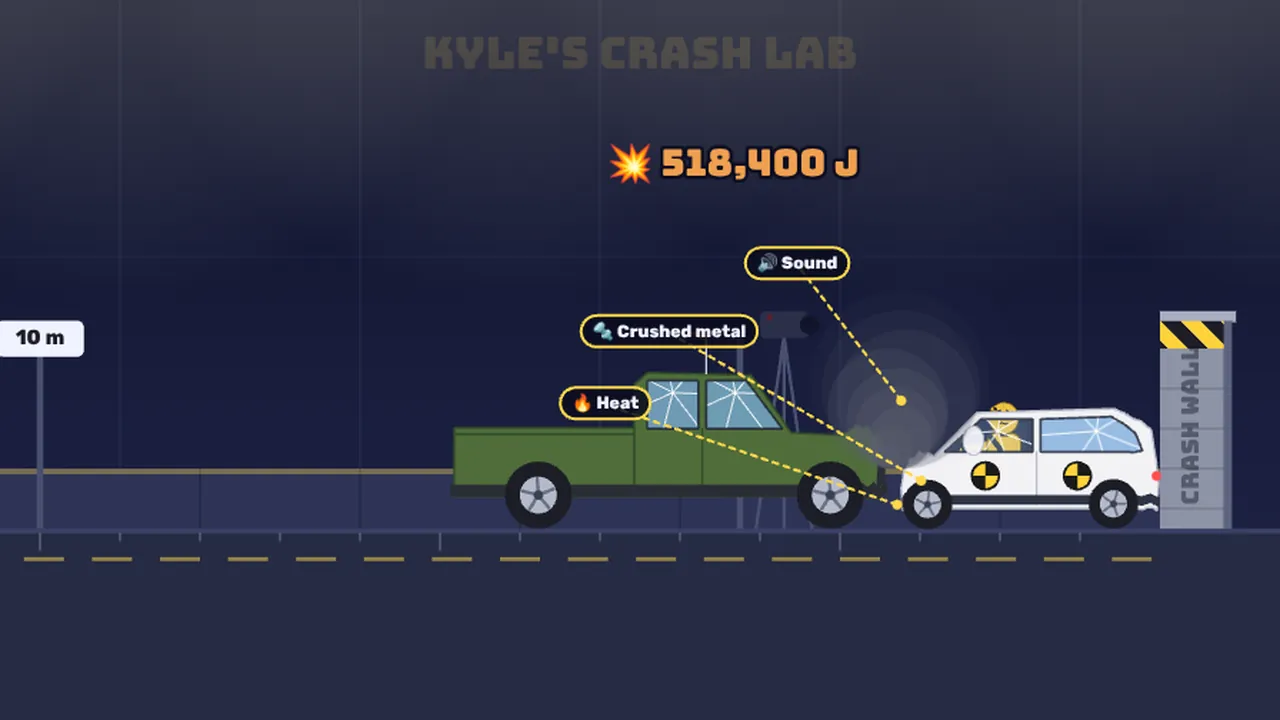
Example 3: a car on the highwayA 1,600 kg car drives at 18 m/s (about 40 mph). Speed squared: 18 × 18 = 324 Times mass: 1,600 × 324 = 518,400 Times ½: 259,200 J
Why speed matters more than mass
Mass and speed do not have the same effect. Kinetic energy is proportional to mass: double the mass and the kinetic energy doubles. But kinetic energy grows with the square of speed: double the speed and the kinetic energy becomes four times as big.
Same 1,600 kg car at…
Kinetic energy
Compared to 9 m/s
9 m/s (about 20 mph)
64,800 J
×1
18 m/s (about 40 mph)
259,200 J
×4
27 m/s (about 60 mph)
583,200 J
×9
36 m/s (about 80 mph)
1,036,800 J
×16
That is why speed is such a big deal in car crashes. Going from 40 mph to 80 mph does not double the energy a crash has to absorb; it multiplies it by four. If you graph kinetic energy against mass you get a straight line, and if you graph it against speed you get a curve that keeps getting steeper. Seeing those two graphs side by side is the heart of the NGSS standard MS-PS3-1.
You can watch this happen in the free Crash Test Lab, where students crash vehicles that double in mass and then the same car at speeds that double, calculating the kinetic energy of each crash.
The most common mistakes
Forgetting the ½. Your answer will be exactly twice as big as it should be.
Not squaring the speed. Multiplying by 18 instead of 324 gives an answer that is far too small.
Squaring the mass instead of the speed. Only the speed is squared.
Doubling instead of squaring. 18² is 18 × 18 = 324, not 18 × 2 = 36.
Wrong units. Using grams, km/h or mph gives a number that is not in joules.
Doing ½ × m first and then squaring the whole thing. Square only the speed: ½ × m × (v × v).
Finding speed or mass from kinetic energy
Sometimes you know the kinetic energy and need the speed or the mass. Rearrange the formula:
v = √(2 × KE ÷ m) · m = 2 × KE ÷ v²
Example 4: finding speedA 0.5 kg ball has 25 J of kinetic energy. How fast is it moving? 2 × 25 = 50, then 50 ÷ 0.5 = 100, then √100 = 10 m/s
Practice problems
1. A 2 kg ball rolls at 3 m/s. What is its kinetic energy?
½ × 2 × 3² = ½ × 2 × 9 = 9 J
2. A 1,000 kg car drives at 10 m/s. Then it speeds up to 20 m/s. Find both kinetic energies.
At 10 m/s: ½ × 1,000 × 100 = 50,000 J. At 20 m/s: ½ × 1,000 × 400 = 200,000 J. Doubling the speed made the kinetic energy four times as big.
3. An 80 kg skier slides at 15 m/s. What is the skier's kinetic energy?
½ × 80 × 15² = ½ × 80 × 225 = 9,000 J
4. A 0.06 kg tennis ball has 12 J of kinetic energy. How fast is it moving?
v = √(2 × 12 ÷ 0.06) = √(24 ÷ 0.06) = √400 = 20 m/s
5. A truck has twice the mass of a car but is going half as fast. Which has more kinetic energy?
The car. Twice the mass doubles the kinetic energy (×2), but half the speed makes it one fourth (×¼). Overall the truck has ×2 × ¼ = ½ of the car's kinetic energy.
Where does kinetic energy go?
Energy is never destroyed. When a moving object slows down, its kinetic energy moves somewhere else: into heat in the brakes, into sound, into bending metal in a crash, or into the motion of something else, like the pins in bowling. Tracking those transfers is the focus of MS-PS3-5. And when an object falls, it gains kinetic energy because its stored gravitational potential energy turns into motion.
Practice with a free kinetic energy simulation
Free, no login, runs on Chromebooks, iPads and phones.
Is a heavier vehicle or a faster one more dangerous? Crash 14 vehicles into Kyle, calculate KE before each one, and graph what happens when you double the mass vs. double the speed.
Drop anything from a feather to a semi truck off a cliff, with or without air resistance, on Earth or other worlds. Calculate GPE and KE, then graph how energy is conserved.
Joules (J). One joule equals one kilogram times meter squared per second squared (kg·m²/s²), which is what you get when you multiply kilograms by meters per second squared in KE = ½mv².
Can kinetic energy be negative?
No. Mass is always positive and speed squared is never negative, so kinetic energy is zero (when the object is not moving) or positive.
Does direction matter for kinetic energy?
No. Kinetic energy depends on speed, not direction. A car moving north at 20 m/s has the same kinetic energy as the same car moving south at 20 m/s.
What happens to kinetic energy if you double the speed?
It becomes four times as large, because speed is squared in the formula: 2² = 4. Tripling the speed makes it nine times as large.
 Grade 8Simulation