Gravitational Potential Energy (GPE = mgh), Explained
What gravitational potential energy is, how to calculate it, how it changes on the Moon or Jupiter, and how it turns into kinetic energy when something falls.
By Mr. Bovee, 8th grade science teacherUpdated 7 min read
What is gravitational potential energy?
Gravitational potential energy (GPE) is energy stored because an object is lifted up against gravity. Lift a book onto a high shelf and you store energy in the Earth-book system. Knock the book off and that stored energy turns into motion.
Three things decide how much GPE an object has: its mass, its height above a chosen zero (usually the ground), and how strong gravity is where it is.
The GPE formula
GPE = m × g × hGPE in joules (J) · m = mass in kg · g = gravity, 9.8 m/s² on Earth · h = height in meters (m)
Because all three are multiplied together, GPE is proportional to each one. Double the mass and GPE doubles. Double the height and GPE doubles. There is no squaring, unlike the kinetic energy formula.
Worked examples
Example 1: a book on a shelfA 2 kg book sits on a shelf 1.5 m high. GPE = 2 × 9.8 × 1.5 = 29.4 J
Example 2: a diving platformA 50 kg diver stands on a 10 m platform. GPE = 50 × 9.8 × 10 = 4,900 J
Example 3: a small planeA 1,100 kg training plane climbs to 300 m above the runway. GPE = 1,100 × 9.8 × 300 = 3,234,000 J (about 3.2 million joules) In the free flight simulator lab Valley Flight School, students calculate this from their own flight data.
Watch out for weight. If a problem gives the weight in newtons instead of the mass in kilograms, the "m × g" part is already done. Just multiply the weight by the height: a 500 N box lifted 2 m has 1,000 J of GPE.
GPE on other planets
The same object at the same height stores different amounts of energy on different worlds, because g changes.
Place
g (m/s²)
GPE of a 2 kg book at 1.5 m
Moon
1.6
4.8 J
Mars
3.7
11.1 J
Earth
9.8
29.4 J
Jupiter (at the cloud tops)
24.8
74.4 J
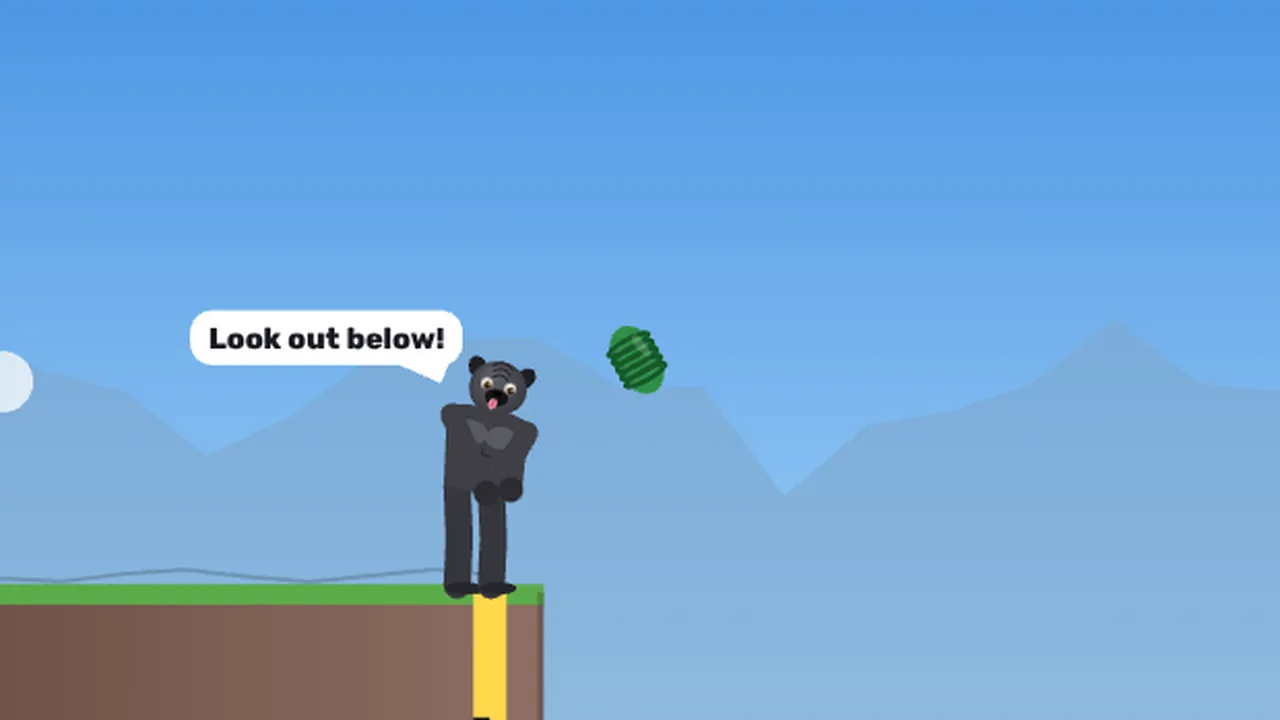
In Cliff Drop, students can drop the same object from the same cliff on Earth, the Moon, Mars and Jupiter and see how much harder it hits where gravity is stronger.
How GPE turns into kinetic energy
When an object falls, it loses height, so it loses GPE. That energy becomes kinetic energy, so the object speeds up. If we ignore air resistance, all of the GPE becomes kinetic energy by the bottom:
GPE at the top = KE at the bottomm × g × h = ½ × m × v², so v = √(2 × g × h)
Example 4: dropping a ball from 5 mv = √(2 × 9.8 × 5) = √98 ≈ 9.9 m/s (with no air resistance)
Notice the mass cancels out. That is why a bowling ball and a baseball dropped from the same height hit the ground at the same time when air resistance is small. In real life, some energy also goes into heating the air (drag), so the object lands a little slower. Tracking that missing energy is part of the NGSS standard MS-PS3-5.
Common mistakes
Using grams instead of kilograms. 500 g is 0.5 kg.
Using centimeters instead of meters. 150 cm is 1.5 m.
Multiplying weight by g again. Weight already includes g.
Measuring height from the wrong place. Use the height above the zero level you chose, like the floor or the bottom of the cliff.
Practice problems
1. A 3 kg backpack sits on a 4 m high balcony. What is its GPE?
3 × 9.8 × 4 = 117.6 J
2. A 0.5 kg ball is held 20 m above the ground. What is its GPE?
0.5 × 9.8 × 20 = 98 J
3. A 60 kg hiker climbs 500 m up a mountain. How much GPE did she gain?
60 × 9.8 × 500 = 294,000 J
4. A 10 kg rock has 980 J of GPE. How high is it?
h = GPE ÷ (m × g) = 980 ÷ (10 × 9.8) = 10 m
5. The same 10 kg rock is moved to a 10 m cliff on Mars (g = 3.7 m/s²). What is its GPE now?
10 × 3.7 × 10 = 370 J, a lot less than on Earth because Mars's gravity is weaker.
Where this fits in NGSS
Gravitational potential energy is the main example in MS-PS3-2, which asks students to model how the stored energy in a system changes when the arrangement of objects changes. The standard emphasizes comparing relative amounts, and calculating with GPE = mgh is a common and helpful way for 8th graders to see those differences.
Practice with a free potential energy simulation
Free, no login, runs on Chromebooks, iPads and phones.
Drop anything from a feather to a semi truck off a cliff, with or without air resistance, on Earth or other worlds. Calculate GPE and KE, then graph how energy is conserved.
Fly a 3D plane from takeoff to landing. Time freezes at 7 lab stops where you use your own flight data to work out forces, Newton's laws, and kinetic and potential energy.
g is the strength of gravity, also called the acceleration due to gravity. On Earth it is about 9.8 m/s² (some classes round to 10). It is about 1.6 m/s² on the Moon, 3.7 m/s² on Mars and 24.8 m/s² on Jupiter.
Can gravitational potential energy be negative?
Yes, if the object is below the height you chose as zero. In middle school the ground or floor is usually chosen as zero, so GPE values are zero or positive.
Why do heavy and light objects hit the ground at the same speed?
Without air resistance, a heavier object has more GPE but also more mass to speed up, and the two effects cancel. The speed at the bottom is √(2gh), which does not depend on mass. Air resistance is what makes a feather fall slower than a hammer on Earth.
Is GPE the same as weight?
No. Weight is a force (mass × g, in newtons). GPE is energy (weight × height, in joules).
 Grade 8Simulation