MS-PS3-5: Energy Transfer and Changes in Kinetic Energy
How to teach MS-PS3-5 with evidence students can see: crashes, drops, glides and braking, plus a claim-evidence-reasoning question you can use tomorrow.
Construct, use, and present arguments to support the claim that when the kinetic energy of an object changes, energy is transferred to or from the object.MS-PS3-5 · Energy · Science and Engineering Practice: Engaging in Argument from Evidence · Crosscutting Concept: Energy and Matter
Clarification statement: evidence for arguments could include an inventory or other representation of the energy before and after the transfer, in the form of temperature changes or the motion of an object.
Assessment boundary: assessment does not include calculations of energy.
Core idea (PS3.B): when the motion energy of an object changes, there is inevitably some other change in energy at the same time.
MS-PS3-5 in plain language
I can explain that energy is never used up. When an object speeds up or slows down, energy moves into or out of it.
I can track where the energy went: into another object's motion, into heat (thermal energy), into sound, or into bending and breaking things.
I can write a claim, back it with evidence from before and after, and explain my reasoning.
Key ideas and vocabulary
Energy transfer: energy moving from one object to another (a bat to a ball, a car to a wall).
Energy transformation: energy changing form (kinetic energy to thermal energy when brakes get hot).
Conservation of energy: the total amount of energy stays the same; it only moves and changes form.
Thermal energy: the energy of moving particles, which shows up as a temperature increase. Friction and drag turn kinetic energy into thermal energy.
Energy inventory: a list or bar chart of where the energy is before and after an event.
Common misconceptions
"The energy was used up." It went somewhere. When a car brakes, its kinetic energy becomes thermal energy in the brakes and tires.
"Energy and force are the same thing." A force can transfer energy, but force is a push or pull, measured in newtons, and energy is measured in joules.
"Sound and heat are too small to count." In a crash or a glide they can account for nearly all of the energy.
A ready-to-use lesson sequence
Hook (5 min). Rub your hands together fast. Ask: "Your hands were moving. Now they are warm. Where did the motion energy go?"
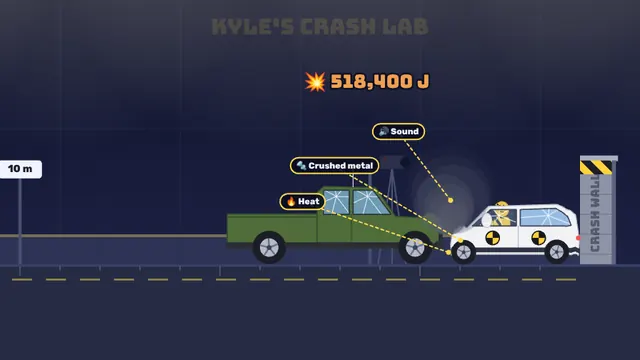
Collisions (15 min). In Crash Test Lab, every crash stops the vehicle completely, and live labels point to the crushed metal, sound and heat. Students make an energy inventory before and after one crash.
Glide and braking (15 min). In Valley Flight School, students glide with the engine at idle and see the plane lose lots of potential energy without gaining much kinetic energy. They argue where the rest went (drag heats the air). Then they brake to a stop and explain the energy transfer to the brakes.
Write the argument (10 min). Students write a claim-evidence-reasoning paragraph using their own data.
Sample CER question
QuestionA bowling ball rolls down the lane and hits the pins. After the hit, the ball is moving slower and the pins fly in all directions. Make a claim about energy and support it with evidence.
Show a strong answer
Claim: When the ball slowed down, energy was transferred from the ball to the pins and the surroundings. Evidence: before the hit the pins had no motion; after the hit the ball moved slower and the pins were moving, and there was a loud crash. Reasoning: the ball's kinetic energy decreased, and energy cannot be destroyed, so it moved into the pins' kinetic energy, plus sound and a little thermal energy.
Try it free with your class
Free, no login, runs on Chromebooks, iPads and phones.
Is a heavier vehicle or a faster one more dangerous? Crash 14 vehicles into Kyle, calculate KE before each one, and graph what happens when you double the mass vs. double the speed.
Fly a 3D plane from takeoff to landing. Time freezes at 7 lab stops where you use your own flight data to work out forces, Newton's laws, and kinetic and potential energy.
Drop anything from a feather to a semi truck off a cliff, with or without air resistance, on Earth or other worlds. Calculate GPE and KE, then graph how energy is conserved.
No. The assessment boundary says assessment does not include calculations of energy. Students build arguments from evidence such as temperature changes or changes in motion. Calculations can still be a helpful way to collect that evidence in class.
What evidence works best for an MS-PS3-5 argument?
An inventory of energy before and after the transfer. For example: a moving car has kinetic energy before a crash and none after, and the evidence of where it went is crushed metal, sound and heat.
How is MS-PS3-5 different from MS-PS3-1?
MS-PS3-1 is about how much kinetic energy an object has based on its mass and speed. MS-PS3-5 is about what happens when that kinetic energy changes: energy has to move to or from the object, and students argue where it went or came from.
NGSS is a registered trademark of WestEd. Neither WestEd nor the lead states and partners that developed the Next Generation Science Standards were involved in the production of this page, and they do not endorse it. Standard text is quoted from the NGSS (Achieve, Inc.).
 Grade 8Simulation