 Grade 8Game
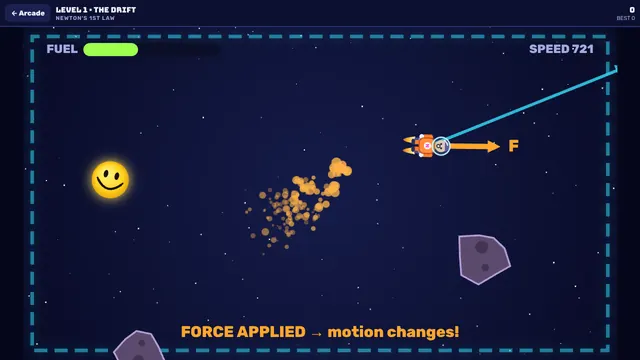
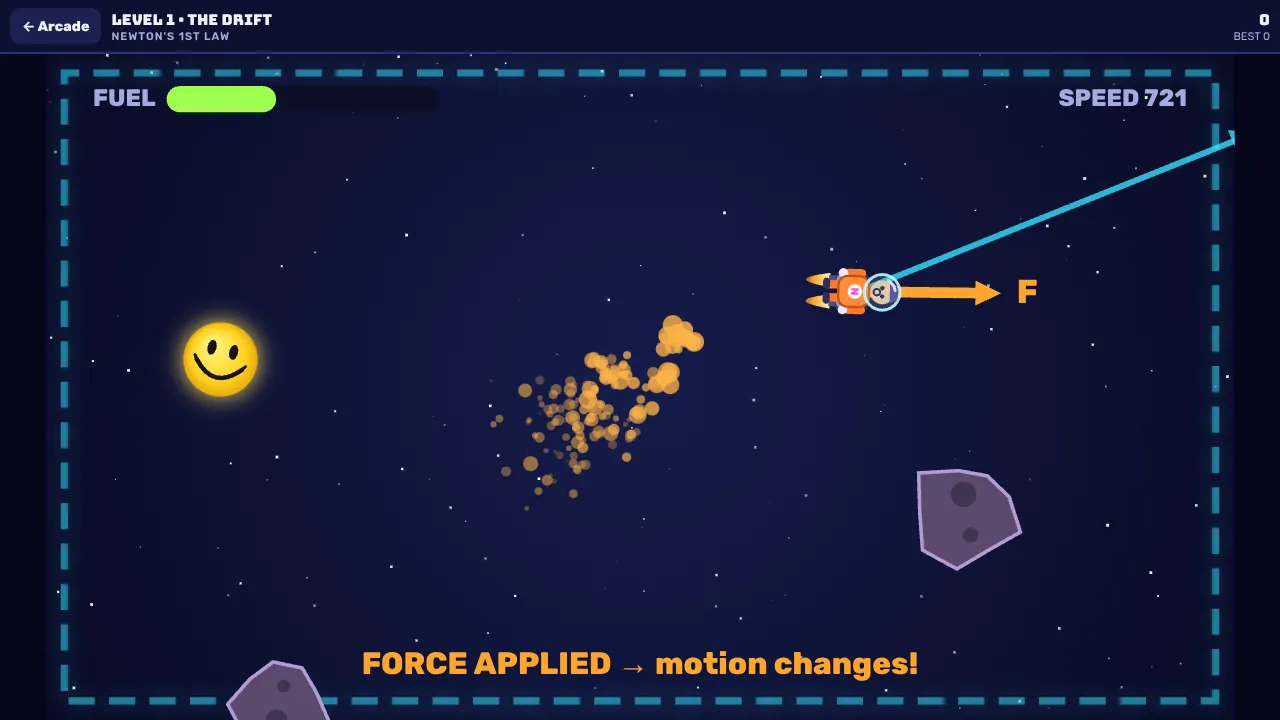
Newton's Arcade
Three arcade games, one for each of Newton's laws of motion, plus a final quiz. Score 100% to become a Newton Master.
FORCES & MOTION · NGSS MS-PS2
Teacher guide & standards
Inertia, F = ma, and equal-and-opposite forces explained with examples middle schoolers already know, plus the misconceptions that trip students up and a quick quiz.
| Law | In one sentence | Everyday example |
|---|---|---|
| 1st: Inertia | Objects keep doing what they are doing unless an unbalanced force acts on them. | You lurch forward when the bus stops suddenly. |
| 2nd: F = ma | More force means more acceleration; more mass means less acceleration. | An empty shopping cart is easier to speed up than a full one. |
| 3rd: Action-reaction | Forces come in equal and opposite pairs. | A swimmer pushes the water back, and the water pushes the swimmer forward. |
An object at rest stays at rest, and an object in motion keeps moving at the same speed in a straight line, unless an unbalanced force acts on it. This tendency to keep doing the same thing is called inertia. More mass means more inertia.
Everyday examples:
The big misconception: many students believe a moving object needs a force to keep it moving. It doesn't. Things slow down on Earth because friction and air resistance are forces pushing against the motion.
To use the first law you need the net force, the total of all the forces. Forces in the same direction add. Forces in opposite directions subtract.
Balanced does not mean "not moving." A plane flying straight and level at a steady speed has balanced forces: lift equals weight and thrust equals drag. Students see this for themselves in the free flight lab Valley Flight School.
The acceleration of an object depends on the net force on it and on its mass. A bigger net force causes a bigger change in motion. A bigger mass needs a bigger force for the same change.
Everyday examples:
Acceleration means any change in motion: speeding up, slowing down or changing direction.
For every force, there is an equal and opposite force. If object A pushes on object B, then B pushes on A with a force of the same size in the opposite direction, at the same moment.
Everyday examples:
Why don't they cancel? The two forces in a pair act on different objects. The ground's push acts on you; your push acts on the ground. Only forces on the same object can cancel.
First law. The ball stays at rest until an unbalanced force acts on it.
Second law. More mass needs more force for the same change in motion.
Third law. You push the boat backward, and the boat pushes you forward.
Second law. a = F ÷ m = 3,000 ÷ 1,000 = 3 m/s²
First law. Your body tends to keep moving in a straight line while the car turns underneath you.
The first and second laws, balanced and unbalanced forces, and net force are the core of MS-PS2-2. The third law, especially in collisions, is the focus of MS-PS2-1, which also asks students to design a solution, like a bumper or a helmet, that protects against collisions.
Free, no login, runs on Chromebooks, iPads and phones.
Grade 8Game
Three arcade games, one for each of Newton's laws of motion, plus a final quiz. Score 100% to become a Newton Master.
 Grade 8Simulation
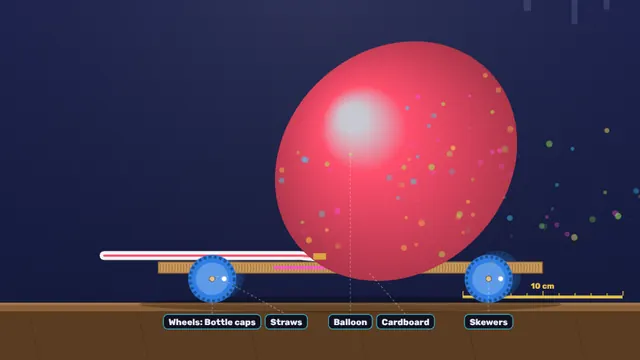
Build a Newton scooter from household parts in a virtual garage, test it, improve it, and lock in a blueprint with a shopping list for the real build.
 Grade 8Simulation
Fly a 3D plane from takeoff to landing. Time freezes at 7 lab stops where you use your own flight data to work out forces, Newton's laws, and kinetic and potential energy.
An object keeps doing what it is already doing (staying still, or moving at the same speed in a straight line) unless an unbalanced force makes it change. This is also called the law of inertia.
The bigger the net force on an object, the more its motion changes, and the more mass it has, the less its motion changes for the same force. In symbols, F = m × a.
Forces come in pairs. When one object pushes on another, the second object pushes back with a force of the same size in the opposite direction.
They act on two different objects. Forces only cancel when they act on the same object.