Scooter Workshop
A free design simulator for the Newton scooter project. Students build a virtual scooter from household parts, test it, improve it, and walk away with a blueprint and a shopping list for the real build. No more aimless searching for ideas online.
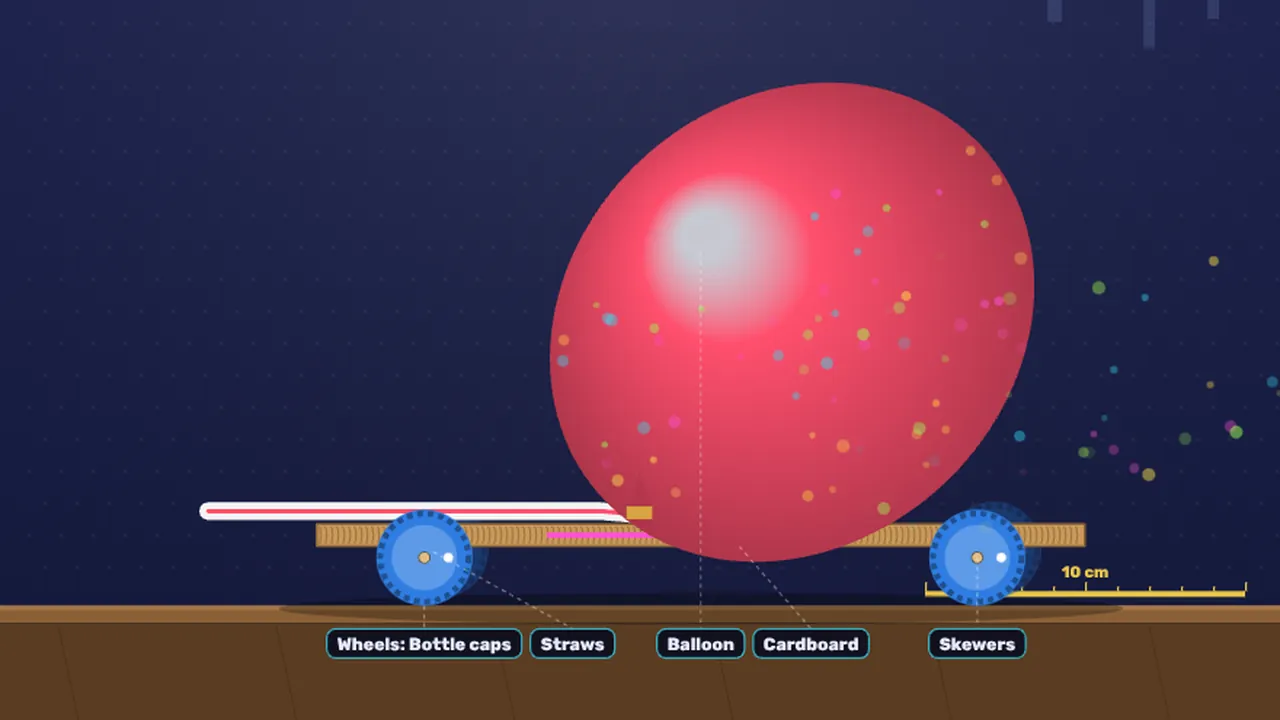
What students do
Students walk into a virtual garage with shelves of common household items, sorted by part: bodies (cardboard, a water bottle, a 2-liter bottle, a foam tray, craft sticks, a paper towel tube, a shoebox lid), axle holders (straws, pen tubes, smoothie straws, paper clip loops, poked holes), axles (skewers, coat hanger wire, paper clips, pencils, chopsticks), wheels (bottle caps, CDs, cardboard circles, jar lids, spools, plastic lids, old toy wheels), power (balloon, two balloons, rubber band wind-up, propeller, mousetrap, Newton slingshot) and extras like rubber band tires, axle spacers, hot glue and a lever arm. They drag parts onto the workbench and snap them together like building blocks. Every part has a card with its pros, cons, and where to find it at home.
When the scooter is ready, students tap Test it and watch it roll down a virtual hallway, with live arrows showing Newton's third law: the balloon pushes air back and the air pushes the scooter forward, or the wheels push the floor back and the floor pushes the scooter forward. Each test reports distance, time, speed, mass, push force and kinetic energy, shows what slowed the scooter down, and gives feedback on that exact design: wheels spinning out, axles rubbing, wobbly wheels, curving into the wall, or a push too weak to beat friction. Students change one part at a time, test again, and finally lock in a blueprint with a to-scale drawing, a shopping list, tools, safety notes and step-by-step build directions.
Drag 38 household parts onto the workbench, or start from one of 6 classic designs.
Roll it down a virtual hallway on a smooth floor, carpet or sidewalk, with live Newton's 3rd law arrows.
Targeted feedback on friction, traction, mass and straightness. Change one part at a time.
A blueprint with a drawing, shopping list, build steps and the data students will collect later.
The science behind Scooter Workshop
Newton's third law
For every action there is an equal and opposite reaction. When one object pushes on another, the second object pushes back just as hard in the opposite direction.
Every power source in the workshop is a third law machine. A balloon or propeller pushes air backward, so the air pushes the scooter forward. A Newton slingshot throws a cup of coins backward, so the coins push the scooter forward. A rubber band wind-up or mousetrap spins the back wheels, the wheels push the floor backward, and the floor pushes the scooter forward. During each test, labeled arrows show both forces in the pair.
Force, mass and friction
F = m × a. The same push speeds up a light scooter more than a heavy one.
The test zone steps the motion forward in tiny time slices: the forward push (balloon thrust, wheel torque limited by traction, or a one-time throw) minus friction gives the net force, and the net force divided by the mass gives the acceleration. Friction comes from axles rubbing inside their holders (less with smooth holders, thin axles and big wheels), wheels rolling on the floor (more on carpet), wobbly or rubbing wheels, and air drag, including the balloon itself. If the push can't beat friction, the scooter doesn't move, and the feedback shows both numbers.
Engineering design
The feedback is written to build good engineering habits. When a student changes exactly one part, the results compare the two tests directly. When they change several parts at once, the workshop points out that it's hard to tell which change made the difference. Each test varies a little, just like real trials. Lab Mode requires at least 3 tests and 2 different designs before students can lock in.
Estimates, not promises
All test results are estimates from a simple model, and the workshop says so on every test. Part masses and sizes are realistic (a bottle cap is about 2 g and 3 cm across, a CD is about 16 g and 12 cm across). Better designs really do go farther, but a real scooter will be different. That's the point: students plan on screen, then build and measure the real thing. The blueprint ends with a data plan for the real scooter: mass, distance, time, speed = distance ÷ time, force (F = ma), kinetic energy (KE = ½mv²) and potential energy on a countertop (PE = mgh).
NGSS alignment
Scooter Workshop supports the design side of the force and motion unit and connects to energy.
| Standard | What it says | How the simulation supports it |
|---|---|---|
| MS-PS2-1 | Apply Newton's Third Law to design a solution to a problem involving the motion of two colliding objects. | Students design a vehicle powered by a third law force pair and explain it in their engineer's notes. Live arrows show the action and reaction for every power source. |
| MS-PS2-2 | Plan an investigation to provide evidence that the change in an object's motion depends on the sum of the forces on the object and the mass of the object. | Each test compares the push with friction and reports mass, push force and speed. Students see heavier scooters speed up less and stall when friction wins. |
| MS-ETS1-2 | Evaluate competing design solutions using a systematic process to determine how well they meet the criteria and constraints of the problem. | The test log compares every design by distance, speed, stars and what changed. |
| MS-ETS1-4 | Develop a model to generate data for iterative testing and modification of a proposed object, tool, or process such that an optimal design can be achieved. | The virtual hallway is a model students use to test, modify and retest a design before they build it. |
| DCI PS2.A | For any pair of interacting objects, the force exerted by the first object on the second is equal in strength to the force the second exerts on the first, but in the opposite direction. The greater the mass of an object, the greater the force needed to achieve the same change in motion. | Both ideas show up in every test: the force pair arrows and the mass and push readouts. |
| Practices | Planning and Carrying Out Investigations; Constructing Explanations and Designing Solutions; Developing and Using Models | Students change one variable at a time, read data from each test, and explain their best change in writing. |
| Crosscutting concept | Cause and Effect; Systems and System Models | Every part affects the whole system: a lighter body, smoother holders or grippier tires each change the result for a reason students can name. |
How to use it in class
- Hook (3 min). Let a balloon go across the room. Ask: "What pushed the balloon?" Then introduce the Newton scooter project.
- Build and test (15 min). Students open Lab Mode, build a first design (or load a classic one from 📐 Ideas), and test it.
- Improve (5 min). Students change one part at a time based on the feedback, aiming for at least 3 tests and 2 designs.
- Lock in (3 min). Students answer two engineer's notes and get their blueprint. They screenshot it to turn in, or print it to take home.
- Build at home. The shopping list and build directions go home with them. Back in class, students measure the real scooter's mass, speed, force and energy.
Discussion questions
- What did your scooter push backward? What pushed your scooter forward?
- Which change made the biggest difference in your tests, and why do you think it worked?
- Why is it important to change only one part at a time?
- Two scooters have the same balloon, but one is twice as heavy. Which one speeds up faster? Use F = m × a to explain.
- Your real scooter won't go exactly as far as the virtual one. What might be different in real life?
Key vocabulary
Newton's third law, action and reaction, force, net force, thrust, mass, friction, traction, air resistance, axle, bearing, speed, prototype, variable, iterate, engineering design process.
Frequently asked questions
Is Scooter Workshop free?
Yes. It runs free in any web browser with no ads, no download, and no login.
What is a Newton scooter?
A small vehicle that moves because it pushes something backward: air from a balloon or propeller, a thrown weight, or the floor (through wheels turned by a rubber band or mousetrap). By Newton's third law, whatever it pushes backward pushes the scooter forward.
Are the test results real?
They are estimates from a simple physics model, and students are told that on every test. The model uses real ideas (thrust or wheel torque, traction, axle and rolling friction, wobble and air drag, and F = ma), so better designs really do go farther, but a real scooter will behave differently. That difference is a great reason to build and measure the real thing.
What do students turn in?
A screenshot of their blueprint. It shows their name, the date, an ID, a to-scale drawing of their design, their best virtual test results, their engineer's notes (in Lab Mode), a shopping list, tools, safety notes and step-by-step build directions. Students can also print it to take home.
Can students use any power source?
The workshop includes six: a balloon jet, two balloons, a rubber band wind-up, a rubber band propeller, a mousetrap motor and a Newton slingshot that throws coins backward. If your class rules allow only some of them, tell students which ones to pick.