What MS-PS4-1 asks students to describe about waves, how to make amplitude and frequency concrete with sound, and a free simulation that turns any student's voice into a live wave.
Use mathematical representations to describe a simple model for waves that includes how the amplitude of a wave is related to the energy in a wave.MS-PS4-1 · Waves and Their Applications · Science and Engineering Practice: Using Mathematics and Computational Thinking · Crosscutting Concept: Patterns
Clarification statement: the emphasis is on describing waves with both qualitative and quantitative thinking. Examples include waves modeled with a jump rope, a slinky, water, seismic activity and sound.
Assessment boundary: does not include electromagnetic waves and is limited to standard repeating waves.
Core idea (PS4.A): a simple wave has a repeating pattern with a specific wavelength, frequency and amplitude.
MS-PS4-1 in plain language
I can label a wave's crest, trough, amplitude and wavelength.
I can explain that frequency is how many waves pass each second, measured in hertz (Hz).
I can explain that a wave with a bigger amplitude carries more energy, like a louder sound or a bigger ocean wave.
I can use numbers to describe a wave, such as its frequency or its wavelength.
Key ideas and vocabulary
Wave: a repeating disturbance that carries energy from place to place without carrying the material along with it.
Amplitude: how far the wave moves from its resting position. For sound, amplitude is loudness.
Frequency: the number of waves per second, in hertz. For sound, frequency is pitch.
Wavelength: the distance from one crest to the next.
Wave speed: speed = frequency × wavelength. Sound travels about 343 m/s in room-temperature air.
Common misconceptions
"Higher pitch means louder." Pitch is frequency and loudness is amplitude. You can sing a high note quietly.
"Waves carry water or air along with them." The material moves back and forth in place; the energy is what travels.
"Sound can travel through space." Sound needs a medium (air, water, a solid). In a vacuum there is no sound.
A ready-to-use lesson sequence
Hook (5 min). Stretch a slinky across the floor and send one gentle pulse, then a big one. Ask: "Which carried more energy? How can you tell?"
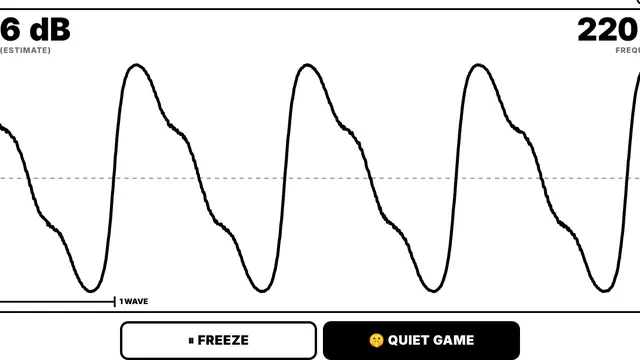
See your voice (15 min). In the free Sound Lab, students hum, sing and talk into the device microphone and watch a live wave. Louder makes taller waves (amplitude); higher makes waves closer together (frequency).
Hit the targets (15 min). Students try to hold specific frequencies for five seconds and find the lowest and highest notes they can sing.
Math connection (10 min). Students use speed = frequency × wavelength to find the wavelength of their lowest and highest notes.
Sample assessment question
QuestionWave A and Wave B have the same frequency. Wave A has an amplitude of 2 cm and Wave B has an amplitude of 6 cm. Which wave carries more energy, and how would they sound different if they were sound waves?
Show the answer
Wave B carries more energy because it has the larger amplitude. As sound waves, they would have the same pitch (same frequency), but Wave B would be much louder.
Try it free with your class
Free, no login, runs on Chromebooks, iPads and phones.
See your own voice as a live sound wave. Learn amplitude and frequency, hit 15 frequency targets in hertz, and find your vocal range. Uses the microphone on an iPad, phone, or Chromebook.
Does MS-PS4-1 include light and other electromagnetic waves?
No. The assessment boundary excludes electromagnetic waves and limits assessment to standard repeating waves. Sound, water waves, slinkies, jump ropes and seismic waves are the suggested examples.
What does 'qualitatively and quantitatively' mean for MS-PS4-1?
Students should describe waves in words (a bigger amplitude carries more energy) and with numbers, such as measuring a frequency in hertz or a wavelength in meters, or using wave speed = frequency × wavelength.
How is amplitude related to energy?
A wave with a larger amplitude carries more energy. For sound, a larger amplitude is a louder sound. For many waves the energy grows with the square of the amplitude, so doubling the amplitude carries about four times the energy.
NGSS is a registered trademark of WestEd. Neither WestEd nor the lead states and partners that developed the Next Generation Science Standards were involved in the production of this page, and they do not endorse it. Standard text is quoted from the NGSS (Achieve, Inc.).
 Grade 8Simulation