Frequency is pitch and amplitude is loudness. Here is what that means, how to measure each one, and how amplitude connects to the energy a wave carries.
By Mr. Bovee, 8th grade science teacherUpdated 7 min read
Sound is a wave
Every sound starts with a vibration. When you talk, your vocal cords vibrate. They push and pull on the air next to them, which pushes on the air next to it, and so on, until the vibration reaches someone's ear. The air does not travel across the room; the energy does. That moving pattern of vibration is a sound wave.
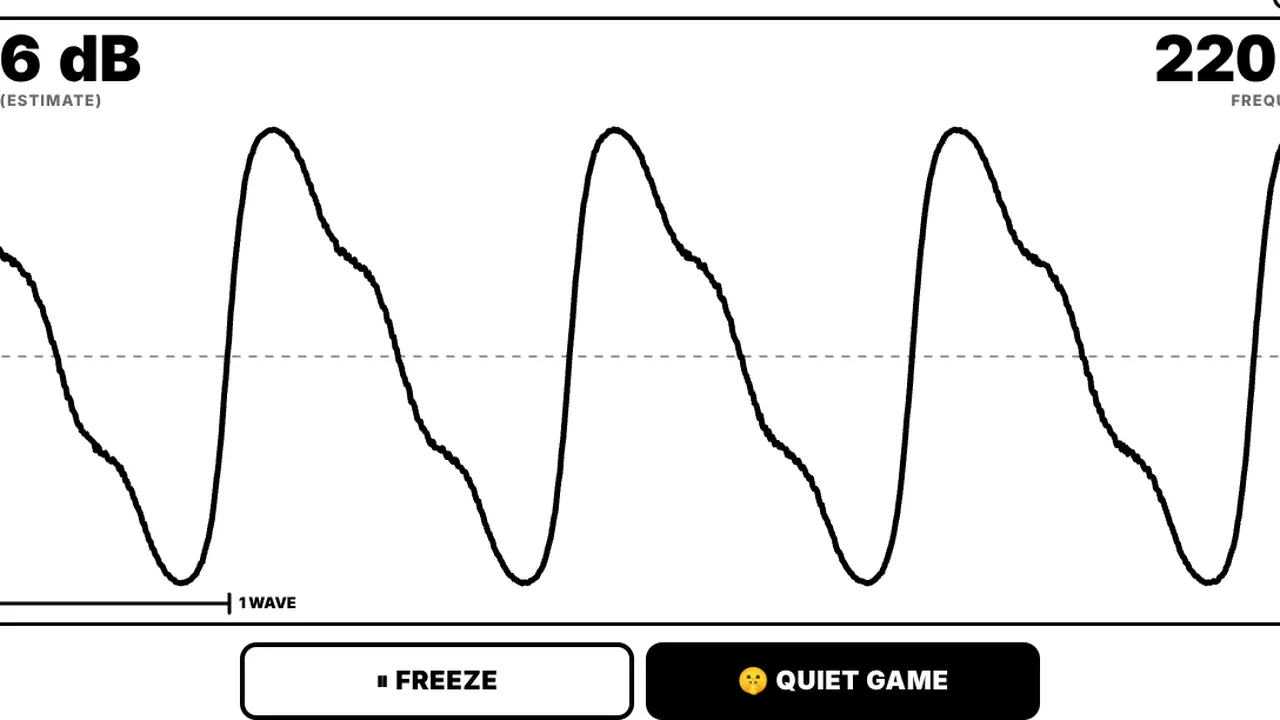
On a graph, a sound wave looks like a repeating up-and-down line. Two measurements describe it: frequency and amplitude.
Frequency = pitch
Frequency is how many complete waves pass a point each second. It is measured in hertz (Hz). 440 Hz means 440 vibrations every second.
High frequency = waves close together = high pitch (a whistle, a bird chirp).
Low frequency = waves spread out = low pitch (a tuba, thunder).
Young people can usually hear from about 20 Hz to 20,000 Hz. The top of that range usually drops as people get older. Speaking voices are near the bottom of the range: adult men typically speak around 85–155 Hz and adult women around 165–255 Hz.
Amplitude = loudness
Amplitude is how big the vibration is: how far the wave moves from its resting position. On a graph, it is the height of the wave.
Big amplitude = tall waves = loud sound.
Small amplitude = short waves = quiet sound.
Loudness is usually measured in decibels (dB). Normal conversation is around 60 dB. Long exposure to sounds above about 85 dB can damage hearing over time, which is why concert workers wear ear protection.
Amplitude and energy
A wave with a bigger amplitude carries more energy. That is why a loud sound can rattle a window and a quiet one can't, and why a big ocean wave can knock you over. For many waves, the energy grows with the square of the amplitude, so a wave with twice the amplitude carries about four times the energy. Connecting amplitude to energy is the heart of the NGSS standard MS-PS4-1.
Frequency vs. amplitude side by side
Frequency
Amplitude
What it measures
How many waves per second
How big each wave is
You hear it as
Pitch (high or low)
Loudness (loud or quiet)
Unit
Hertz (Hz)
Loudness in decibels (dB)
On a wave graph
How close together the waves are
How tall the waves are
Changes the energy?
Not for these comparisons
Yes: bigger amplitude, more energy
Wavelength and wave speed
The wavelength is the distance from one crest (top) to the next. Frequency and wavelength are linked by the speed of the wave:
wave speed = frequency × wavelengthSound travels about 343 m/s in room-temperature air
Example: the note A (440 Hz)wavelength = speed ÷ frequency = 343 ÷ 440 ≈ 0.78 m
Example: a deep voice (110 Hz)wavelength = 343 ÷ 110 ≈ 3.1 m. Lower notes have longer waves.
Try it with your own voice
The free Sound Lab turns any phone, tablet or Chromebook microphone into a live wave display. Hum quietly, then loudly, and watch the amplitude grow. Slide from a low note to a high note and watch the waves squeeze together. The guided lab has students hold ten target frequencies for five seconds each and find the lowest and highest notes they can sing.
Practice questions
1. You turn up the volume on a song without changing the song. What changes: frequency or amplitude?
Amplitude. The pitch stays the same; the waves just get taller.
2. A guitar string vibrates 330 times per second. What is its frequency?
330 Hz.
3. Wave A has waves closer together than Wave B. Which has the higher pitch?
Wave A. Waves closer together means a higher frequency, which is a higher pitch.
4. What is the wavelength of a 686 Hz sound in air (speed 343 m/s)?
343 ÷ 686 = 0.5 m
5. Which carries more energy: a whisper or a shout at the same pitch?
The shout. It has a bigger amplitude, and a bigger amplitude carries more energy.
See your own voice as a wave
Free, no login, runs on Chromebooks, iPads and phones.
See your own voice as a live sound wave. Learn amplitude and frequency, hit 15 frequency targets in hertz, and find your vocal range. Uses the microphone on an iPad, phone, or Chromebook.
No. Frequency controls pitch (high or low). Amplitude controls loudness. A high note can be quiet and a low note can be loud.
What is the range of human hearing?
About 20 Hz to 20,000 Hz for young people with healthy hearing. The upper limit usually drops with age, so many adults cannot hear sounds above about 15,000 Hz.
What unit is used for loudness?
Decibels (dB). The decibel scale is not linear: every increase of 10 dB is ten times the sound intensity, and it sounds roughly twice as loud.
Can sound travel through space?
No. Sound is a vibration that needs a medium, like air, water or a solid, to travel through. Space is almost a perfect vacuum, so there is nothing to carry the vibrations.
 Grade 8Simulation