Escape Room Review
A free science review game. Students open 30 locks across 6 rooms with only 5 lives. Every wrong answer costs a life and opens a step-by-step walkthrough, so struggling students get the practice they need before the test.
What students do
Students type their name, pick a unit to review, and pick one of three escape rooms. Every room's door is sealed with 5 locks, and each lock is one question. A right answer opens the lock with a burst of sparks. After 5 locks the door opens and students move on to the next room. Each of the 6 rooms is one big idea from the unit, so by the last door students have reviewed the whole unit.
Students have 5 lives for the whole escape. A wrong answer costs one life, and the threat in the room gets closer. Then students work through the problem themselves, one step at a time (a workshop blueprint in Santa's Workshop, the manual override in Reactor Meltdown, an ancient scroll in Temple of Energy), and answer it again. Nobody moves on until they get the right answer themselves. Every room is a checkpoint: lose all 5 lives and students see what they missed, then restart that room with new questions and 5 fresh lives. Students who paid attention in class escape quickly. Students who are struggling work through every miss until they can escape too.
You're on the naughty list and locked in Santa's workshop with a dying flashlight. Creepy elves peek out, and each miss brings Santa closer.
Escape a space station before the reactor melts down. Each miss burns a shield, and the core temperature climbs.
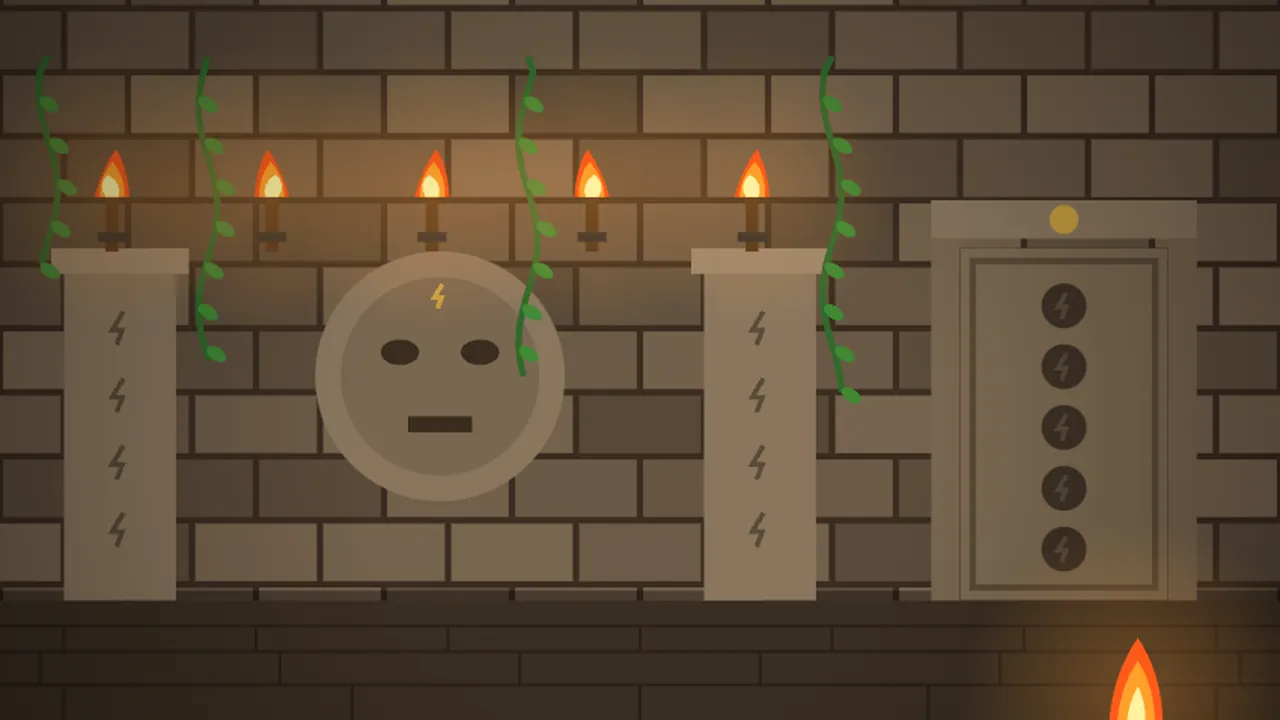
Solve ancient glyph locks in a lost temple. Each miss blows out a torch, and the giant boulder rolls closer.
A targeted hint for the exact mistake, then the student works it out one step at a time. Every room is a checkpoint.
What's in the kinetic and potential energy review
Each room draws 5 questions from a bank of 6 to 9 question types, with new numbers every time. Students sitting next to each other get different questions, so they compare how they solved it, not their answers. Every formula a question needs is shown on the question, and a Help button has all the formulas and vocabulary.
| Room | Big idea | Example questions |
|---|---|---|
| 1 | Energy & joules | What energy is, the joule, converting kJ and MJ to joules, kinetic vs. potential, types of stored energy |
| 2 | Potential energy | Which object has the most GPE, what GPE depends on, doubling height or mass, GPE on other planets |
| 3 | The GPE equation | Calculate GPE = m × g × h on Earth and other planets, compare two boxes, triple the height |
| 4 | Kinetic energy | Calculate KE = ½ × m × v², find a classmate's mistake, KE at rest, KE on the Moon, compare two carts |
| 5 | Mass vs. speed | Doubling or tripling mass vs. speed, KE graph shapes, reading a KE graph, finding the pattern in a KE table, crash speeds |
| 6 | Conservation of energy | GPE turning into KE, roller coasters and pendulums, energy bar charts, where energy goes in a crash |
The science
Gravitational potential energy: GPE = m × g × h. On Earth, g = 9.8 m/s².
Stored energy from height. The higher and heavier an object is, the more GPE it has. Students calculate it on Earth, the Moon, Mars, and Jupiter, and see what happens when the height triples.
Kinetic energy: KE = ½ × m × v². Doubling the mass doubles KE, but doubling the speed makes KE four times bigger.
The energy of motion. Questions target the most common mistakes: forgetting the ½, multiplying the speed by 2 instead of by itself, and thinking gravity changes kinetic energy.
Energy is never created or destroyed. It only changes forms.
As an object falls, GPE transforms into KE and the total stays the same. In a crash or a bounce, energy transforms into sound, heat, and crushing or moving other things.
NGSS alignment
The kinetic and potential energy review supports these Next Generation Science Standards for middle school physical science.
| Standard | What it says | How the review supports it |
|---|---|---|
| MS-PS3-1 | Construct and interpret graphical displays of data to describe the relationships of kinetic energy to the mass of an object and to the speed of an object. | Room 5: doubling and tripling mass vs. speed, KE graph shapes, and reading values off KE graphs. |
| MS-PS3-2 | Develop a model to describe that when the arrangement of objects interacting at a distance changes, different amounts of potential energy are stored in the system. | Rooms 2 and 3: how height, mass, and gravity change the GPE stored in an object-Earth system. |
| MS-PS3-5 | Construct, use, and present arguments to support the claim that when the kinetic energy of an object changes, energy is transferred to or from the object. | Room 6: energy transformations and transfers, like where a car's kinetic energy goes in a crash. |
| DCI PS3.A, PS3.B | Definitions of Energy; Conservation of Energy and Energy Transfer | All 6 rooms. |
| Crosscutting concepts | Energy and Matter; Scale, Proportion, and Quantity | Proportional reasoning (×2, ×4, ×9) and energy tracking with bar charts. |
The escape room is a review of ideas students have already explored. It pairs well with Cliff Drop and Crash Test Lab, where students collect the data behind these ideas.
How to use it in class
The escape room works best the day or two before a unit test, as a station, or as homework.
- Launch (3 min). Tell students the rules: 5 lives, 30 locks, and a wrong answer starts a walkthrough. Have them pick a room. Students who don't like scary games can skip Santa's Workshop or turn off its jump scares.
- Escape (25 to 40 min). Students work on their own. Circulate and look for students restarting the same room more than once; their list of misses shows exactly which ideas to reteach.
- Submit (2 min). Students screenshot their certificate and turn it in through your learning platform. The checkpoint restarts number shows how many times they ran out of lives.
- Early finishers. Try another room for a higher first-try score, or a perfect run with all 5 lives.
- Debrief (5 min). Use the discussion questions below.
Discussion questions
- Which room was hardest for you? What idea in that room do you want to review before the test?
- Why does doubling the speed change kinetic energy more than doubling the mass?
- A ball bounces lower each time. Where did the "missing" energy go?
- What mistake did you fix today by working through the steps?
Key vocabulary
Energy, joule (J), potential energy, gravitational potential energy (GPE), kinetic energy (KE), mass, speed, squared, directly proportional, law of conservation of energy, transform, thermal energy, air resistance, terminal velocity.
Frequently asked questions
Is the escape room review free?
Yes. It is free to play in any web browser with no ads, no download, and no login.
How long does it take?
Plan for about 30 to 45 minutes. Students who know the unit well finish faster. Students who lose all 5 lives restart that room, so they may need the whole period.
What happens when a student gets a question wrong?
They lose one life, see a hint about their specific mistake when there is one, and then they work through the problem one step at a time on their own. Then they answer it again themselves. They can't move on until they get it right on their own. Each step has a short reading timer so students can't click through without reading. If they miss it again, they get a second, clearer explanation and a message to ask the teacher for help, then try again. Only the first miss on a question costs a life.
What happens when a student loses all 5 lives?
Every room is a checkpoint. The student sees the question that got them, worked out step by step, plus a list of every question they missed with the correct answer. Then they restart that room with new questions and 5 fresh lives. Rooms they already escaped stay escaped.
Is the scary theme OK for school?
Santa's Workshop is a spooky holiday theme with a creepy cartoon Santa and elves and no blood or gore. Santa crawls around the room, and each time a student loses a battery he jumps out for about a second, with a bigger jump scare when the last battery dies. Students can turn jump scares off on the start screen. Students who don't like scary games can pick Reactor Meltdown or Temple of Energy instead.
How do students show they finished?
When they escape, students see a certificate with their name, the unit, how many locks they opened on the first try, lives left, checkpoint restarts, time, date, and an ID. They take a screenshot and submit it.
Will more units be added?
Yes. Kinetic and potential energy is the first unit. Waves, electricity and magnetism, and natural selection are coming, using the same escape rooms, so students can pick any unit to review.