What MS-ESS1-3 really asks (hint: not memorizing planet facts), how to build a sense of scale, and a free game where students fly to every planet and collect real NASA data.
Analyze and interpret data to determine scale properties of objects in the solar system.MS-ESS1-3 · Earth's Place in the Universe · Science and Engineering Practice: Analyzing and Interpreting Data · Crosscutting Concept: Scale, Proportion, and Quantity
Clarification statement: the emphasis is on analyzing data from Earth-based instruments, space-based telescopes and spacecraft to determine similarities and differences among solar system objects. Examples of scale properties include the sizes of an object's layers (such as crust and atmosphere), surface features (such as volcanoes) and orbital radius. Data can include statistical information, drawings, photographs and models.
Assessment boundary: assessment does not include recalling facts about properties of the planets and other solar system bodies.
Core idea (ESS1.B): the solar system consists of the sun and a collection of objects, including planets, their moons and asteroids, that are held in orbit around the sun by its gravitational pull.
MS-ESS1-3 in plain language
I can read a data table about the planets and compare their sizes, distances, temperatures and gravity.
I can use a scale model to show how big and far apart solar system objects really are.
I can find patterns, like the inner planets being small and rocky and the outer planets being large and gassy.
Key ideas and vocabulary
Scale: how big or far something is compared to something else. Jupiter's diameter is about 11 times Earth's.
Astronomical unit (AU): the average Earth-sun distance, about 150 million km.
Orbital radius: how far a planet is from the sun.
Terrestrial and gas/ice giant planets: small rocky inner planets versus large outer planets made mostly of gases and ices.
Surface gravity: how strongly a planet pulls on objects at its surface. It changes how much a person would weigh.
Common misconceptions
"The planets are evenly spaced and close together." Textbook diagrams squeeze them together. The distances between the outer planets are enormous compared to the inner ones.
"Bigger planets always have much stronger gravity." Gravity at the surface depends on both mass and size. Saturn is far more massive than Earth, but its surface gravity is only a little stronger.
"Space is mostly full of planets and asteroids." Even the asteroid belt is mostly empty space.
A ready-to-use lesson sequence
Hook (5 min). Ask students to draw the sun and Earth to scale. Then reveal that if Earth were a peppercorn, the sun would be a bowling ball about 24 m (26 yards) away.
Explore with data (25 min). In Planet Tour, students fly to any planet, observe it from orbit, and record its color, size compared to Earth, temperature, gravity and a famous feature in a planet data table built from NASA fact sheets.
Find patterns (10 min). Students sort the planets by size and by distance and describe at least two patterns.
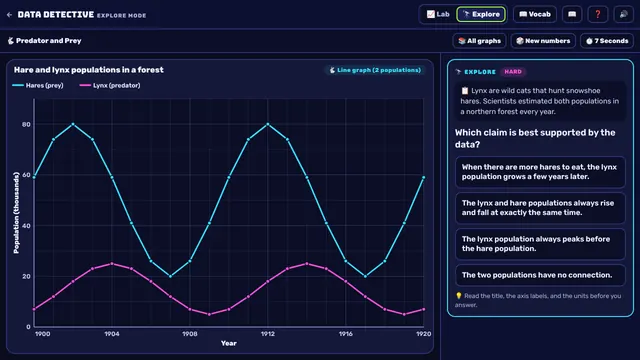
Graph skills (optional).Data Detective gives practice reading the kinds of graphs and tables this standard depends on.
Sample assessment question
QuestionUse the data: Earth's diameter is about 12,700 km and Jupiter's is about 139,800 km. About how many Earths would fit side by side across Jupiter?
Show the answer
About 11. 139,800 ÷ 12,700 ≈ 11.
Try it free with your class
Free, no login, runs on Chromebooks, iPads and phones.
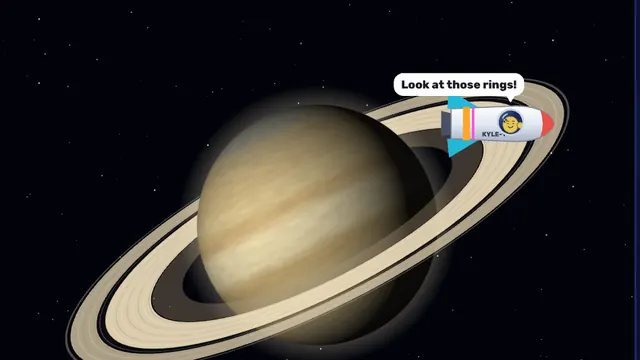
Fly Kyle the crash test dummy to all 8 planets. Study each one from orbit, then drop him in with and without his super suit to see what's really down there.
Practice reading 15 science graphs and data tables, from bar graphs to climate graphs, with new numbers every time. Miss one and get walked through it step by step.
Do students need to memorize planet facts for MS-ESS1-3?
No. The assessment boundary says assessment does not include recalling facts about properties of the planets and other solar system bodies. Students analyze data that is given to them.
What data sources fit MS-ESS1-3?
Data from Earth-based instruments, space-based telescopes and spacecraft, shown as tables, drawings, photos and models. NASA's planetary fact sheets are a reliable source of sizes, distances and gravity values.
What grade is MS-ESS1-3 taught in?
It is a middle school standard. In states that follow an integrated model, like California, space systems are usually taught in 8th grade. In discipline-specific courses it is often part of 6th grade Earth science.
NGSS is a registered trademark of WestEd. Neither WestEd nor the lead states and partners that developed the Next Generation Science Standards were involved in the production of this page, and they do not endorse it. Standard text is quoted from the NGSS (Achieve, Inc.).
 Grade 8Game